
Once acted upon by a generating force such as wind or a passing boat, large waves drive forward and gravity tries to fill every trough with a crest. This chasing of crest after trough is an effort to achieve the equilibrium of a flat surface. Gravity wants to create calm seas, which is why most waves larger than ripples are known as gravity waves.
Most gravity waves are produced by wind, and their size is
determined by the wind's speed, duration, and "fetch," 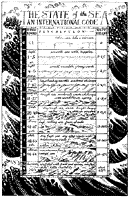 or the distance it
blows unhindered. An increase in any of those factors results in
increased wave height, which is the distance from the bottom of a
trough to the top of a crest; greater wave length, which is the distance
from one crest to the next; and longer period, which is the time it takes
a wave to pass from crest to crest.
or the distance it
blows unhindered. An increase in any of those factors results in
increased wave height, which is the distance from the bottom of a
trough to the top of a crest; greater wave length, which is the distance
from one crest to the next; and longer period, which is the time it takes
a wave to pass from crest to crest.
Wind can produce several distinctive kinds of waves. Ripples grow into wavelets, then into increasingly larger waves. In the open ocean, sea waves (also called chop) are always under the direct influence of the wind and are likely to have smooth, rounded troughs between sharply peaked crests. They often occur in complex patterns, with waves of many sizes coming from several directions, creating confused, choppy, unpredictable seas. The roughest seas are typically composed of short, steep, sea waves produced by storms.
Swell waves travel beyond the wind, either leaving the area where it is blowing or continuing on after the wind has ceased.
COPYRIGHT 1996 GLENN WOLFF/JERRY DENNIS/HARPER COLLINS -- ALL RIGHTS RESERVED